Rent vs Buy Calculator
Compare the cost of renting with buying a home
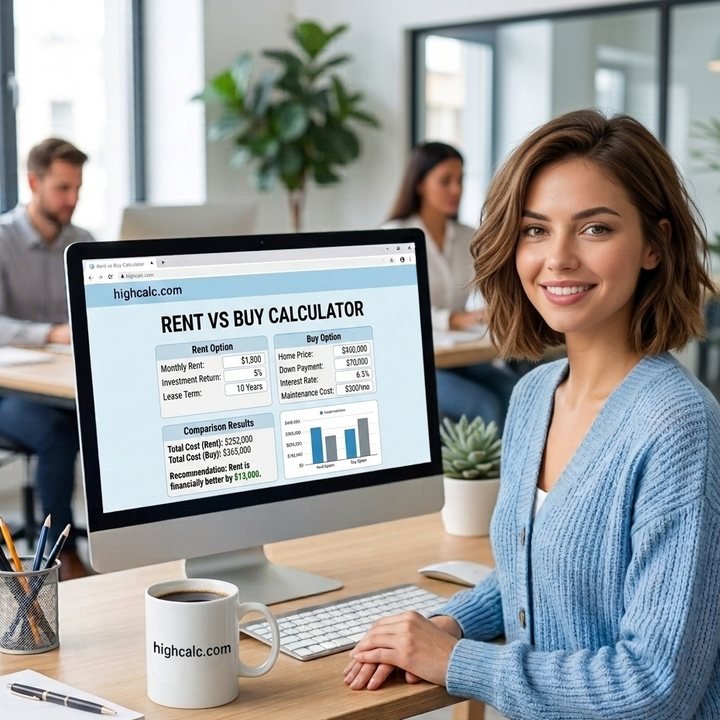
Rent vs Buy Calculator: Should You Rent or Buy a Home?
Our free rent vs buy calculator compares the real cost of renting with buying a home over the number of years you choose. Enter your rent, the home price, your down payment and the mortgage rate. The calculator shows what each path costs, how much equity you build, which option leaves you with more money, and when buying starts to pay off.
Quick answer: with $1,800 rent rising 3% a year, against a $400,000 home with 20% down at 6.5%, renting comes out ahead by about $56,644 after 10 years. Buying only catches up after about 27 years 4 months. Change the numbers to match your own market and the answer can flip.
How the Comparison Works
A simple monthly payment comparison leaves out too much. A mortgage builds equity, while rent does not, but buying also brings taxes, insurance, repairs and large costs at purchase and sale. To compare fairly, the calculator measures net worth at the end of the period for both choices.
The renter keeps the cash a buyer would spend on the down payment and closing costs, and invests it. When owning costs more than rent each month, the renter invests the difference too. When renting costs more, the buyer invests it instead.
How Long You Stay Changes the Answer
Buying has large upfront and exit costs, so time matters more than almost anything else. The table shows the same example home and rent over different periods.
| Time in the home | Better option | Advantage | Renting net worth | Buying net worth |
|---|---|---|---|---|
| 5 years | Renting | $48,426 | $184,758 | $136,332 |
| 10 years | Renting | $56,644 | $290,673 | $234,029 |
| 15 years | Renting | $57,786 | $411,393 | $353,606 |
| 20 years | Renting | $47,736 | $548,705 | $500,969 |
| 30 years | Buying | $31,777 | $900,384 | $932,161 |
What Costs Are Included
For owning, the calculator adds the mortgage payment, property tax, home insurance and maintenance, plus closing costs at purchase and selling costs at the end. You can see the first-year monthly cost of owning next to your mortgage payment, which is usually much higher than the payment alone. For renting, it uses your monthly rent and the yearly increase. Use the Assumptions tab to change tax, insurance, maintenance, home price growth, rent increases and investment return.
What Can Change the Result
Home price growth has a large effect. In the example, raising growth from 3% to 5% a year moves the 10-year result to buying ahead by about $38,305. Rent matters too: at $2,200 a month, buying is ahead by about $13,305 after 10 years. A higher investment return favors renting, since the saved cash grows faster. To check the loan side, use the mortgage calculator, the down payment calculator or the amortization calculator.
Beyond the Numbers
Renting offers flexibility if you may move, while owning offers stability and control over your space. The calculator also leaves out mortgage insurance, association fees and tax deductions, so treat the results as a guide. For investing ideas, try the investment calculator to see how saved money could grow.
Who Uses a Rent vs Buy Calculator?
First-time buyers deciding whether to buy now, renters who want to know how long a home must be kept to pay off, people relocating for work, and families comparing neighborhoods or cities. Results are estimates for general information, not financial advice.
How to Use This Rent vs Buy Calculator
Enter your rent
Type the monthly rent you pay or expect to pay.
Enter the home details
Add the home price, down payment percentage and mortgage rate.
Choose how many years
Set how long you expect to stay in the home.
Review the assumptions
Open the Assumptions tab to adjust rent increases, taxes, insurance, maintenance, price growth and investment return.
Click "Calculate Rent vs Buy"
See which option leaves you better off, by how much, and when buying breaks even.